The Best 2-Week Interrail Routes for Your Interrail Adventure
When you first begin planning your interrail trip one of the first questions I had was how long shall we go for. Often a lot of people land on 2 weeks. This is a good amount of time to see the key capitals without feeling as though you are compromising.
Interrailing is the perfect way to see a lot of Europe in a short amount of time. People go for a month, some go for far less. When I travelled, I went for five weeks and visited 10 countries and 15 destinations. Some of my closest friends have done three cities in just over a week. By the time my own trip hit the two-week mark, I’d already visited around six different countries, so there is absolutely a way to pack a lot in.
That said, you do have to be realistic. In the nicest way, its time to get out of your delusions – you’re not going to see all of Europe in two weeks, that’s simply not possible. You could travel Europe for a lifetime and not see it all. The key is to prioritise your route and be honest about what you actually want to see in that fortnight.
Summary
- There are various routes that you can take for a beautiful 2 week trip, and they dont all have to be the classic routes – if you are looking for something a bit different keep reading!
- The best 2-week starting routes from the UK are Paris, Brussels or Amsterdam via Eurostar from London St Pancras, if you want to arrive to mainland Europe via train
- You’ll need a Global Pass or Plus Pass if you’re crossing multiple countries
- Budget around £1,400 all-in for two weeks – for everything
- Prague–Vienna–Budapest is the classic first-timer route and it’s covered in full below
- You can absolutely see a brilliant chunk of Europe in two weeks by train
What Route to Take For a Two Week Interrail Trip?
If you want to follow my route, you could take the first half of my full itinerary and finish in the Czech Republic. That gets you roughly two weeks visiting Paris, Bern, Lake Como, Vienna, Hallstatt and Prague, a really solid balance of iconic cities and quieter, more scenic stops. It’s also a natural and easy route to do from the UK.
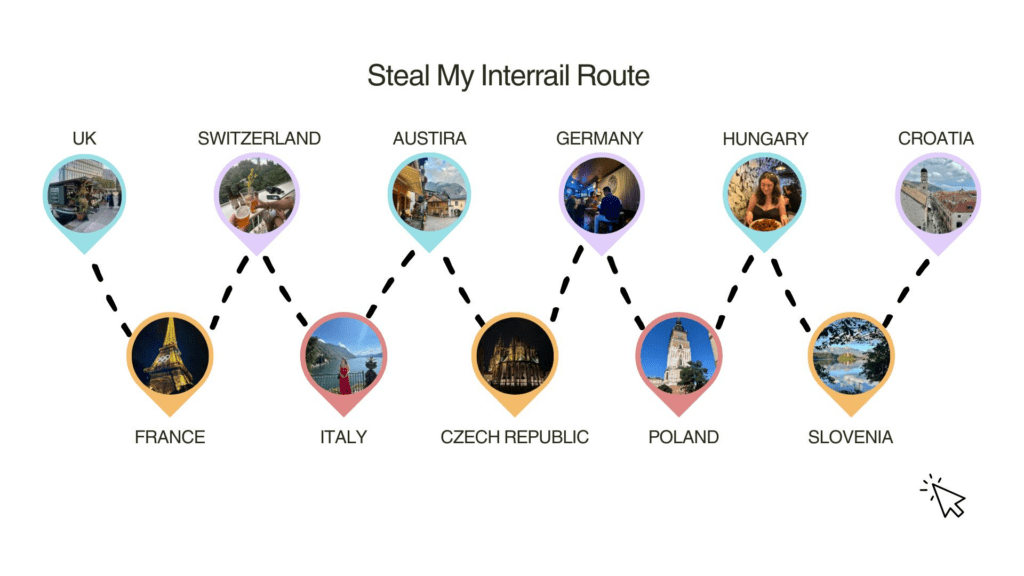
You can also adapt my route. For example fly into Poland and work your way back through Germany and the Czech Republic – there are loads of ways to make the route your own. Or follow my guide on building the best route for your trip.
Other Highly Recommended 2 Week Interrail Routes
As much as I put time into perfecting my own route, there are loads of brilliant alternatives to choose from too:
Emma’s Classic Interrail Route: Prague, Vienna and Budapest in 2 Weeks
Prague, Vienna and Budapest is a classic interrail route for a reason and possibly one of the most explored itineraries in Europe. I named it the Emma Classic Route after our expert travel writer, who explored this exact itinerary in 2024. I have personally visited both Budapest and Vienna twice: once on family trips and once while interrailing. Both times offered something completely different, which tells you everything you need to know about how much these cities have to give. Vienna is grand in a way that almost catches you off guard. Everything is nearly too pretty and the city has an energy that rewards you for just wandering. You can catch an opera for a surprisingly affordable price, visit the incredible St Stephen’s Cathedral and take full advantage of the fact that around 50% of the city is dedicated to green space. It is the kind of place that makes you slow down without even realising it. Prague, on the other hand, can be whatever you need it to be. Some people come for the nightlife and the cheap drinks, which is completely valid. I came for the Charles Bridge, John Lennon’s Wall, the famously tiny street that actually has its own traffic light system to manage the foot traffic, the old bookshops and of course Prague Castle, which is every bit as impressive as it sounds. Budapest is a city I suspect I will keep returning to for the rest of my life. Every visit has offered something new. One of my absolute favourite things to do, and I have done it both times, is to take a night cruise along the river and watch the Parliament building light up the water. The whole place genuinely glows. Do not leave without visiting the Fisherman’s Bastion for the views and making at least one stop at the infamous For Sale Pub.
The Classic European Interrail Loop: Paris to Venice in 2 Weeks
The Classic European Loop is one of the best interrail routes in Europe for first-time travellers and it genuinely earns that reputation. In two weeks on a 7-day or 10-day Global Pass you can move through six countries, and the whole thing flows in a logical direction with no doubling back. The legs break down like this: Paris to Amsterdam is around 3 hours 30 minutes, Amsterdam to Berlin is 6 to 7 hours, Berlin to Prague is 4 to 5 hours and Prague to Vienna is roughly 4 hours. All very manageable, especially with a good playlist and a window seat. The standout leg is the overnight OBB from Vienna to Venice. If you take the train from Wien Hbf at 22:03 and arrive at Venezia Santa Lucia at 08:34, there are zero changes the entire journey. You fall asleep in Vienna and wake up in Venice. It saves you a full hostel night and is a must-do experience. Do be prepared for some pretty mid sleep though, so pack your eye mask and earplugs. Seat reservations are required on some legs and are not included in your pass, so factor that into your budget before you go.
The Iron Curtain Interrail Route: Best Budget Eastern Europe Itinerary
The Iron Curtain Route is one of the best budget interrail routes through Eastern Europe and the one that travellers consistently rate. Starting in Berlin and finishing in Budapest via Krakow, Warsaw, Prague and Vienna, this itinerary takes you through some of the most historically significant cities in Europe at a fraction of what you would spend travelling in the west. The Berlin to Krakow leg can be done overnight, and I would genuinely recommend doing it that way. I completed it overnight on my own interrail trip and it meant we did not have to pay for an extra night of accommodation, which makes a real difference when you are keeping costs tight. You board the train, sleep, and arrive in Krakow early morning. It is one of those interrail moments that makes you feel like you are really living the experience. Please, for the love of your own sanity, bring everything you need to make it comfortable: eye mask, earplugs, a blanket and a neck pillow. And pre-warning: do not expect the best sleep of your life. From there the route stays very manageable. Prague to Vienna is around 4 hours and Vienna to Budapest is around 2.5 hours, which means your travel days never feel like too much of a slog. You arrive with energy to actually see the place rather than collapsing at the hostel. The cities in Eastern Europe are extraordinary, the history is unlike anywhere else and your money goes significantly further than it does in the north or west.
The Mediterranean Interrail Arc: Barcelona to Rome in 2 Weeks
Although I have not visited every stop on the Mediterranean Arc personally, these places do not exactly need my endorsement. They speak entirely for themselves. This is the interrail route for anyone who wants their two weeks to feel like a proper visual highlight reel: sunshine, coastline, world-class food and some of the most photographed places in Europe all connected in one logical route hugging the Mediterranean coast. Starting in Barcelona, three days is the minimum. You need time for Gaudi’s architecture, the Gothic Quarter, the tapas and the kind of beach bar you end up staying at until the sun goes down. From there the route moves through Montpellier, Nice and Monaco before crossing into Italy via Cinque Terre and finishing in Rome. The coastal train from Nice towards Italy is covered by your pass and the views from the window are said to be some of the best of any rail journey in Europe. It is worth being honest that this is one of the more expensive routes on the list since you are in Western Europe throughout, and accommodation in places like Nice and Rome runs high in peak summer. But the payoff in scenery, food and sunshine is genuinely very hard to argue with.
The Balkans Interrail Route: Ljubljana to Budapest via Sarajevo and Mostar
In my opinion, the Balkans interrail route is one of the most unique itineraries you can do in Europe. The destinations are less commonly visited than the classic routes but to me that is honestly a big part of the appeal. You go somewhere that feels genuinely off the radar and you come back with stories that most people have never heard before. The route begins in Ljubljana and takes in Lake Bled, one of Europe’s most photographed natural landmarks. Let me give you a little heads up about Lake Bled before you arrive with sky-high expectations. The lake itself is stunning, genuinely one of those places that looks exactly like the photos. The town, however, is pretty mid. Do not go expecting a charming little village to match the scenery because you will be disappointed. Focus on the lake, and only the lake. I would recommend two things while you are there: visit Bled Castle and hire a rowing boat to row yourself over to the island. That second one is a memory you will not forget and honestly one of my favourite moments from interrailing. From there the route moves through Zagreb, Sarajevo, Belgrade and Budapest. Mostar, which sits just a short trip from Sarajevo, is possibly one of the most beautiful small cities I have ever visited. It is hard to describe it as anything but a fairytale. The architecture, the famous bridge, the whole atmosphere is unlike anything else on this list or anywhere else I have been. It has been years since my last visit and I still remember it clearly, which tells you everything. If Dubrovnik sneaks into your route you can also do Mostar as a day trip, which is how I visited. The whole region is significantly more budget friendly than the routes further west, with some travellers spending around 25 to 45 pounds per day. And the Bar to Belgrade railway is considered one of the most scenic train journeys in Europe.
Scandinavia Interrail Route: Copenhagen to Bergen via the Norwegian Fjords
For those of you wanting to head north, let me be upfront: Scandinavia is still very much an untapped area of Europe for me, but it is absolutely on my list and I suspect it will not stay unticked for much longer. So for now what I can offer you is honest research and everything I have been told by people who have done it. And everything points in the same direction: go. The Scandinavia interrail route is the one that people describe as graduating you from a traveller to an explorer. I love that framing and based on everything I know about Scandinavia, it feels completely accurate. The route runs from Copenhagen to Stockholm to Oslo, then west on the Bergen Railway through the Norwegian fjords, which is widely rated one of the greatest train journeys on earth, finishing in Bergen. The fjords have come up in almost every conversation I have had about Scandinavian travel without exception. The one thing I really need you to factor in before you book is cost. Scandinavia is expensive and there is no way around that. A realistic daily budget is 65 to 95 pounds and you should plan around that figure honestly rather than hoping to stretch less. If budget is your main concern there are better routes on this list for you. But if you have the means and you want a trip that genuinely takes your breath away, this one comes strongly recommended.
Which Route Is Right For You?
If you aren’t sure which route is right for you, you aren’t alone. A blank piece of paper is an extremely overwhelming start, so I have created a quiz for you to see which of these routes above might be the best fit for you.
Which 2-Week Interrail Route Is Right for You?
Take our six-question quiz to find out which Interrail route across Europe suits your travel style, budget and dream experiences. Choose from six curated two-week routes — from classic city hops to Mediterranean coast rail journeys and Scandinavian fjord adventures.
Emma’s Classic Interrail Route — Prague, Vienna & Budapest
Stops: Prague · Vienna · Budapest
Budget: £38–50 per day · Duration: 2 weeks · Cities: 3
I have personally visited both Budapest and Vienna twice and both cities offered something completely different each time, which tells you everything you need to know. Vienna is grand in a way that catches you off guard: nearly too pretty, with about 50% of the city dedicated to green space and an opera you can catch for a surprisingly affordable price. Prague can be whatever you need it to be. Budapest is the one I keep going back to: take a night cruise, watch the Parliament building glow on the water and make at least one stop at the infamous For Sale Pub.
- Wander Prague Castle and the Charles Bridge at sunrise before the crowds arrive
- Catch an opera in Vienna for a surprisingly affordable price
- Take a night cruise down the Danube and watch the Budapest Parliament glow on the water
- Short train hops of 2.5 to 4 hours between each city
- Almost zero mandatory seat reservation fees on this route
The Classic European Interrail Loop — Paris to Venice
Stops: Paris · Amsterdam · Berlin · Prague · Vienna · Budapest · Venice
Budget: £47–68 per day · Duration: 2 weeks · Cities: 7
In two weeks you can move through six countries with no doubling back: Paris to Amsterdam is around 3 hours 30 minutes, Amsterdam to Berlin is 6 to 7 hours, Berlin to Prague is 4 to 5 hours and Prague to Vienna is roughly 4 hours. The standout leg is the overnight ÖBB from Wien Hbf at 22:03 arriving Venice at 08:34 with zero changes: you fall asleep in Vienna and wake up in Venice, saving a full hostel night. Pack your eye mask and earplugs though: sleep quality is decent but do not go in expecting miracles.
- Paris, Amsterdam, Berlin, Prague, Vienna, Budapest and Venice all in one two-week trip
- The overnight ÖBB from Wien Hbf at 22:03 arrives Venice at 08:34 with zero changes
- You fall asleep in Vienna and wake up in Venice, saving a full hostel night
- Budget an extra £70–100 for seat reservations across this route
The Iron Curtain Interrail Route — Berlin to Budapest via Krakow
Stops: Berlin · Krakow · Warsaw · Prague · Vienna · Budapest
Budget: £34–48 per day · Duration: 2 weeks · Cities: 6
Starting in Berlin and finishing in Budapest via Krakow, Warsaw, Prague and Vienna, this route covers some of the most historically significant cities in Europe at a fraction of what you would spend travelling in the west. The Berlin to Krakow leg done overnight saves a full night of accommodation. Prague to Vienna is around 4 hours and Vienna to Budapest is 2.5 hours, making your travel days feel manageable, and your money goes significantly further here than anywhere else on this list.
- The Berlin to Krakow leg done overnight saves a full hostel night
- Krakow is one of the cheapest and most underrated Interrail cities in Europe
- Dinners for under £5 and hostel dorms from around £10–14 a night
- Almost no mandatory seat reservation fees anywhere on this route
The Mediterranean Arc Interrail Route — Barcelona to Rome
Stops: Barcelona · Nice · Monaco · Cinque Terre · Rome
Budget: £45–66 per day · Duration: 2 weeks · Cities: 5
Starting in Barcelona with at least three days for Gaudí, the Gothic Quarter and the beach bars, the route hugs the Mediterranean coast through Montpellier, Nice and Monaco before crossing into Italy via Cinque Terre and finishing in Rome. It is one of the more expensive routes since you are in Western Europe throughout, and accommodation in Nice and Rome runs high in peak summer, but the payoff in scenery, food and sunshine is genuinely very hard to argue with.
- Three days minimum in Barcelona for Gaudí, the Gothic Quarter and the beach bars
- The coastal train from Nice to Italy is covered by your pass and the views are incredible
- Cinque Terre is everything the photos promise — stay at least two nights
- Finish with three days in Rome for the Colosseum, Vatican and as much pasta as possible
The Balkans & Adriatic Interrail Route — Ljubljana to Budapest
Stops: Ljubljana · Lake Bled · Zagreb · Sarajevo · Belgrade · Budapest
Budget: £30–45 per day · Duration: 2 weeks · Cities: 6
The destinations are less commonly visited than the classic routes and that is honestly a big part of the appeal. Lake Bled is stunning — hire a rowing boat and row to the island. Mostar, just a short trip from Sarajevo, is possibly one of the most beautiful small cities in Europe. The whole region runs around £30–45 a day and the Bar to Belgrade railway is considered one of the most scenic train journeys in Europe.
- Hire a rowing boat at Lake Bled and row to the island — one of the best Interrail memories
- Mostar is possibly the most beautiful small city in Europe
- The Bar to Belgrade railway is one of the most scenic train journeys in Europe
- The cheapest Interrail route in this guide at £30–45 per day all in
Scandinavia & the Fjords Interrail Route — Copenhagen to Bergen
Stops: Copenhagen · Stockholm · Oslo · Flåm · Bergen
Budget: £65–95 per day · Duration: 2 weeks · Cities: 5
The route runs from Copenhagen to Stockholm to Oslo, then west on the Bergen Railway through the Norwegian fjords, which is widely rated one of the greatest train journeys on earth, finishing in Bergen. A realistic daily budget is £65–95 and you should plan around that figure rather than hoping to stretch less. Copenhagen deserves two to three nights for the food scene alone, and long summer daylight hours in June and July make your days feel almost limitless.
- The Bergen Railway is widely rated one of the greatest train journeys on earth
- Copenhagen deserves two to three nights for the food scene alone
- Long summer daylight hours make your days feel almost limitless in June and July
Which Route is Right for You?
Six questions based on where you want to go, what you want to do and how much you want to spend. We will handle the rest.
What Interrail Pass Would Be the Best For a 2 Week Interrail Trip?
The best pass for a 2-week trip is the Global Pass or Plus Pass if you’re crossing countries, or the One Country Pass if you plan to stay in one country.
There are now three passes you can get from the official Interrail website, this includes the one country pass, the global pass and the internal plus pass. If you want to cross over into different countries, you must get the global pass or the plus pass.
Interrail Pass comparison
As of 2026, there are three passes available from the official Interrail website – prices shown in GBP 2nd class adult (approx.)
| 🌍 Global Pass | 🏳️ One Country Pass | ✨ Plus Pass (Beta) | |
|---|---|---|---|
| COVERAGE | 33 European countries | 1 country of your choice (from 33) | 33 countries (same as Global) |
| BEST FOR | Multi-country trips – Prague + Vienna + Budapest, or longer adventures | Deep exploration of one country, e.g. Italy or Germany solo | Countries with expensive/mandatory reservations (France, Italy, Spain) |
| PASS TYPES | Flexi Set days within 1–2 months Continuous Unlimited for 15 days–3 months | Flexi 3–8 days within 1 month | Flexi only 5 or 7 days within 1 month |
| STARTING PRICE | From ~£189 (4 days, adult) | Varies by country – generally cheaper | Marginally more than equivalent Global Pass |
| SEAT RESERVATIONS | Not included — pay extra on high-speed & night trains | Not included – same extra costs apply | Included for most trains ✓ |
| TRAVEL IN OWN COUNTRY | 1 outbound + 1 inbound day only | Not valid in your home country | Same as Global Pass |
| ACTIVATION WINDOW | Within 11 months of purchase | Within 11 months of purchase | Within 3 months of purchase ⚠️ |
| APP REQUIRED? | Rail Planner app (free) | Rail Planner app (free) | Rail Planner app (free) |
When I went interrailing I used the Global Pass and it worked brilliantly. Both the Global Pass and the Plus Pass cover the Eurostar out of the UK, you just can’t use travel days within the UK itself, but the outbound leg from London is fine.
If you are looking for a detailed break down of the passes you can read more about them here.
Flexi vs Continuous – Which Suits 2 Weeks?
For a two-week trip, a Flexi pass is almost always the better option. It lets you use travel days strategically, you’re not paying for days when you’re settled in a city and exploring on foot. A 7-day Global Flexi Pass used within one month is the sweet spot for most 2-week routes.
Where to start an Interrail trip from the UK
I would recommend that you start your interrail trip in London, if you are using the Eurostar to get into mainland Europe. All Eurostar services in the UK depart from London St Pancras International, so getting to London is your first step. If you’re based further north, you’ll need to travel down, sorry, northerners. However, here it the silver lining…
London is so big that you can see loads even in a half day! When we went interrailing we stayed for half a day and had a lovely time.
The Eurostar also isn’t limited to Paris, which was our first stop. Services run to Brussels, Amsterdam and Lille too, giving you a solid choice of starting points depending on the direction of your route.
If the Eurostar isn’t for you, flying to a European city to start your interrail journey is a perfectly valid option, particularly if you want to begin further east or in Scandinavia. Dont let the interrail snobs tell you, you cant take any flights!!
Estimated Total Cost (Pass + Reservations + Accommodation)
For a two-week trip I’d estimate around £1,400 all-in. That’s based on my own five-week trip costing approximately £3,500 in total, scaled down proportionally. Your actual costs will vary depending on: which pass you choose, whether you stay in hostels or hotels, how many seat reservations you need, how much you eat out, and whether you plan nights out. Use our Interrail Calculator for a more personalised estimate.
One thing I would say is that having a £1,400 budget for a two week trip should be plenty and get you interrailing quite cushiony. When we went we budgeted around £50 per person per night, which meant we were looking for accommodation around £100 per night. This budget lended itself to a lot of different types of accommodations – hotels, hostels, apartments etc. You may want to use that as a ball mark for your own budgeting and planning.
Budget Tip
Track your spending in detail for the first week. You’ll quickly spot patterns you didn’t expect (yes, that fresh pastry habit adds up). Carry a small expenses tracker, use our digital travel planner, or download a free budgeting app so nothing sneaks up on you.
Final Verdict
There are so many different routes you can take to explore Europe. This blog post simply covers the most popular trialed and tested routes. Two weeks is enough to visit four or five destinations properly, mix big city energy with somewhere quieter and more scenic, eat incredible food, meet people you’ll still be messaging years later, and come home feeling like you have just had one of the best trips of your life. The key is really to just be smart with your route. No matter what route you choose, whether that be the classic interrail routes or the more adventurous Balkan routes, interrail is one of the most adaptive ways to travel.
No matter what route you choose you are bound to have the best experience of your life, and try not to deep it too much – you can always travel the places you have missed another time!
Ready to Plan Your Interrail Trip?
If you’re ready to start planning, head over to our full Interrail Hub for city guides, itinerary ideas, packing guides, and destination inspiration. And if you want a proper planning head start, our digital city planners for iPad and Androids have everything you need in one place. I recommend you buy the interrail or general planner for your trip.
Frequently Asked Questions About Interrailing Planning
It varies a lot depending on duration, countries and your travel style. However as a benchmark budget around £1,400. Setting a nightly accommodation budget of around £30–50 and leaning into free sights and walking tours keeps costs manageable without sacrificing quality.
Start by writing down every destination you actually want to visit without overthinking the geography. Then pick your one non-negotiable, and if travelling with others, ask them to do the same. From there, look at how those anchor points connect by train and build your route around them. Mix cities with natural stops to avoid burnout, and aim for a maximum of two or three major destination changes per week on a longer trip. Read our how to plan and interrail blog here.
Absolutely – interrailing is actually a great introduction to independent travel because the rail network gives you a clear framework. That said, don’t push yourself to see too many places in quick succession; the new systems can feel overwhelming. If it’s your very first trip, go with some structure: book trains in advance, confirm accommodation before you arrive, and keep the spontaneous approach for what you do within each destination rather than how you get there. Start with two to three weeks, pick a manageable number of stops, and build in buffer days. The learning curve is part of the fun. And take safety precautions.
For most two-week multi-country routes, a 7-day Global Flexi Pass is the best value. It gives you enough travel days for the main legs without paying for days you’re not on a train. If you’re visiting countries like France, Spain or Italy where seat reservations are mandatory and expensive, the Plus Pass, which includes reservations, is worth considering.
Why Readers Trust Travel Girls Corner
Travel Girls Corner is built by women who genuinely love to travel, and who actually do it. Every guide, itinerary, and recommendation is written by female travellers who are constantly exploring the world, from long European rail adventures to far-flung global escapes.
Our founder has been travelling for years, including a five-week Interrail journey across Europe, and many of our contributors are always on the move, discovering new cities, revisiting favourites, and keeping our guides modern and up to date.
What makes us different?
- Travel guides written exclusively by women
- Authentic, firsthand experiences combined with curated research
- Hidden gems alongside iconic highlights
- Modern, comprehensive city guides, not just surface-level lists
- Real recommendations we genuinely love
We go beyond tourist attractions. You will find stylish jazz bars, local neighbourhood cafes, boutique stays, cultural spots, practical transport advice, and detailed planning support, all designed to help women travel confidently and experience destinations fully.
We are not a faceless travel blog brand. We are ordinary women who travel often, care deeply, and share what we discover. Meet the team here.
Editorial Policy
At Travel Girls Corner, everything we share is rooted in real travel experiences. Our content is created by a team of women travelers of different ages and backgrounds, offering well-rounded perspectives on destinations, itineraries, and travel tips. We are always welcoming more women to join our team, helping us amplify diverse voices and share even more amazing travel experiences.
We combine personal experience with thoughtful research to provide accurate, practical, and honest guidance. While we strive to ensure information is as current as possible at the time of publication, travel details like opening hours, transport schedules, or local conditions can change. We encourage readers to double-check important details before planning their trips.
Some links on this site may be affiliate links, which means we may earn a small commission at no extra cost to you. This helps us keep Travel Girls Corner running while continuing to share authentic, experience-led travel content.
Every recommendation, guide, and tip reflects experiences we genuinely love, from hidden gems to must-see highlights. We do not exaggerate or sensationalize; we share what we truly encounter and enjoy, with honesty and integrity at the heart of our editorial approach.